









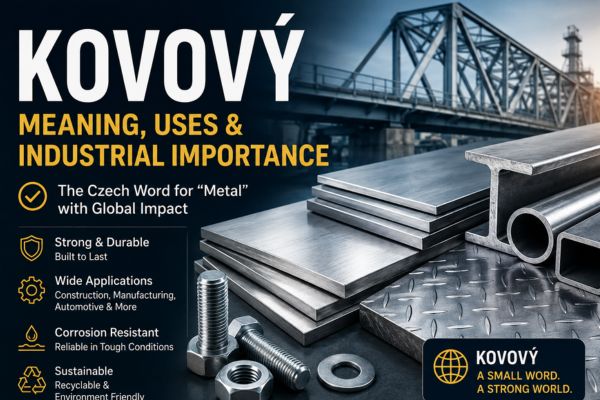
The word Kovový appears in manufacturing catalogs, engineering documents, construction projects, and everyday Czech language. Although it may seem unfamiliar to English speakers, the term simply means “metal” or “metallic” and describes something made from or relating to metal. Whether you are translating technical documents, shopping for products, or learning Czech, understanding the meaning of Kovový provides valuable context.
This article explores the definition of Kovový, its linguistic origins, common applications, industrial importance, and why the word frequently appears in engineering, architecture, and manufacturing. By the end, you will have a clear understanding of how this simple adjective plays an important role in both language and industry.
Table of Contents
ToggleWhat Does Kovový Mean?
Kovový is a Czech adjective derived from the noun kov, which means metal. In English, the word translates to metal, metallic, or made of metal, depending on the sentence. It describes objects, materials, structures, or surfaces that consist primarily of metal or possess metallic characteristics.
Unlike a brand name or personal name, Kovový functions as a descriptive adjective. Czech grammar changes adjective endings according to gender, number, and grammatical case. Therefore, you may also encounter forms such as kovová, kovové, or kovových. Despite these variations, the core meaning remains connected to metal and metallic materials.
The Origin of the Word Kovový
The Czech language belongs to the West Slavic language family, sharing similarities with Slovak and Polish. The root word kov has referred to metal for centuries and appears in numerous technical and everyday expressions. By adding the adjective-forming suffix, Czech creates kovový, allowing speakers to describe metal objects naturally.
This grammatical structure resembles English adjectives such as “wooden,” “plastic,” or “ceramic.” Instead of naming the material itself, the adjective explains what something is made from. As a result, Kovový appears frequently in product descriptions, industrial manuals, engineering specifications, and architectural documents throughout the Czech Republic.
Common Uses of Kovový in Everyday Language
People encounter the word Kovový in many ordinary situations, especially when describing household items, furniture, construction materials, and public infrastructure. Because metal remains one of the world’s most widely used materials, the adjective naturally appears in thousands of product names and technical descriptions.
For example, a kovový stůl refers to a metal table, while kovové dveře means metal doors. Similarly, kovový most translates as a metal bridge, and kovový plot describes a metal fence. These examples demonstrate how the adjective functions exactly like its English counterpart while remaining flexible across different contexts.
Examples of Common Expressions
Understanding frequently used phrases makes learning the word much easier. Several expressions appear regularly in both commercial and technical settings.
Household Products
Furniture manufacturers often advertise kovový nábytek, meaning metal furniture. Customers may also see kovové police for metal shelves, kovové postele for metal beds, or kovové skříně for metal cabinets. These products emphasize durability, strength, and modern design, making them popular in homes, offices, schools, and commercial buildings.
Construction Materials
The construction industry frequently uses terms like kovové konstrukce, referring to metal structures. Engineers may specify kovové nosníky for steel beams or kovové zábradlí for metal railings. Such descriptions help architects, builders, and suppliers identify the exact materials required for a project.
Industrial Equipment
Factories and manufacturing plants rely heavily on metal components. Consequently, technical manuals often mention kovové součásti, meaning metal parts, or kovové nástroje, referring to metal tools. These expressions ensure precision when assembling machinery or maintaining industrial equipment.
Why Metal Materials Remain So Important
Understanding Kovový also means appreciating the importance of metal itself. Metals continue to support modern civilization because they combine strength, durability, and versatility better than many alternative materials. Engineers choose metals for applications requiring structural integrity, heat resistance, electrical conductivity, or long service life.
Steel, aluminum, copper, stainless steel, and titanium each provide unique advantages depending on the intended use. Therefore, when a product description includes the word Kovový, it often signals reliability, durability, and performance. These qualities explain why metal products remain essential across transportation, construction, manufacturing, healthcare, and energy industries.
Advantages of Metal Products
Metal products offer several practical benefits compared with materials such as plastic or wood. First, they generally provide greater structural strength, allowing buildings, bridges, and machinery to withstand significant loads. Second, many metals resist wear and deformation even after years of continuous use.
Additionally, metal products often require less frequent replacement because they maintain their integrity under demanding conditions. Many alloys also resist corrosion when properly treated, extending product life while reducing maintenance costs. These characteristics explain why industries consistently favor metallic materials for critical infrastructure.
Kovový in Manufacturing and Engineering
Manufacturing companies frequently include the adjective Kovový in product catalogs because material selection directly influences quality and performance. Whether producing automotive components, industrial machinery, consumer appliances, or architectural fixtures, engineers specify metal materials to satisfy safety, durability, and regulatory requirements.
Modern production techniques such as laser cutting, CNC machining, welding, casting, and metal fabrication have further expanded the possibilities of metal manufacturing. As technology advances, companies continue developing lighter, stronger, and more corrosion-resistant alloys that improve efficiency while reducing environmental impact.
Quality Standards for Metal Components
Industrial manufacturers evaluate metal products using strict quality standards. They examine tensile strength, hardness, corrosion resistance, dimensional accuracy, and surface finish before approving finished components. Because many applications involve public safety, maintaining consistent quality remains essential throughout the manufacturing process.
These inspections help ensure that bridges remain secure, machinery operates safely, and construction materials perform as expected over decades of service. Consequently, the simple adjective Kovový often represents far more than material type; it reflects engineering precision and manufacturing excellence.
Learning Czech Through Practical Vocabulary
For language learners, Kovový provides an excellent example of how adjectives function in Czech. Instead of memorizing isolated vocabulary, students benefit from learning complete expressions that appear naturally in conversation and written communication. Technical vocabulary becomes especially valuable for professionals working in engineering, manufacturing, architecture, or international trade.
Because many European industries cooperate across borders, understanding terms such as Kovový improves communication when reviewing product catalogs, technical drawings, instruction manuals, or construction specifications. Even basic familiarity with these words helps professionals interpret documents more accurately and confidently.
Why You May See Kovový Online
Internet users frequently search for Kovový after encountering the word in product listings, manufacturing websites, online stores, or translated documents. Since automated translation tools occasionally preserve the original Czech word, readers naturally seek clarification about its meaning before purchasing products or interpreting technical information.
Search interest has also increased because global commerce increasingly connects manufacturers across different countries. As international suppliers publish multilingual catalogs, technical terminology such as Kovový becomes more visible to audiences outside the Czech Republic, making accurate understanding increasingly valuable.
Conclusion
Kovový is a straightforward yet important Czech adjective meaning metal, metallic, or made of metal. While it is not the name of a person or company, the word appears extensively in construction, manufacturing, engineering, architecture, and everyday product descriptions. Understanding its meaning helps readers interpret technical documents, product catalogs, and commercial listings with greater confidence. As industries continue relying on durable metallic materials, the term Kovový will remain a common and useful part of both Czech vocabulary and international technical communication.